
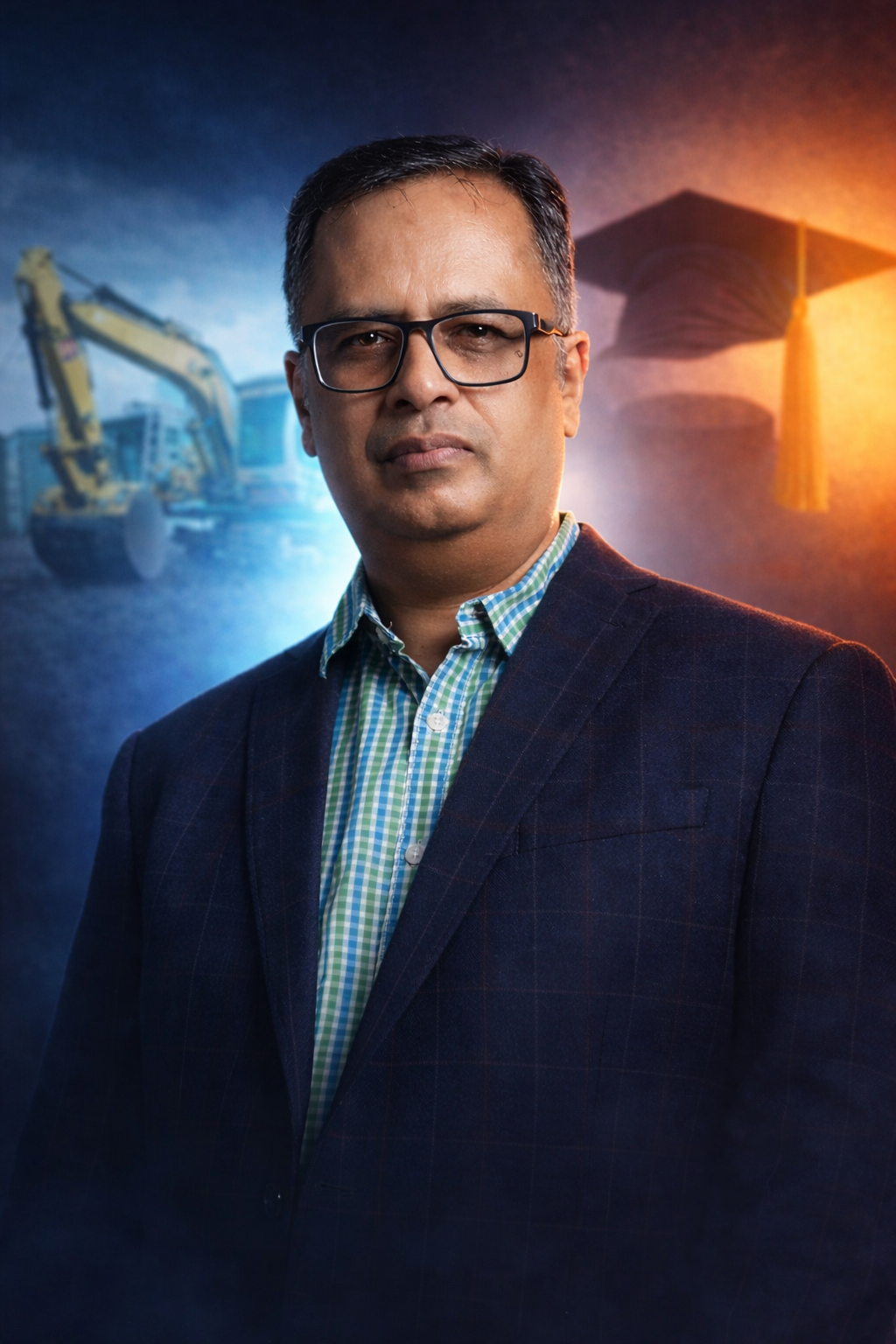
In an era where careers are often reduced to job titles, packages, and social validation, Dr. S.P. Mishra stands out as a rare voice of clarity—someone who has lived the corporate grind, led large-scale businesses, and then consciously chosen to pivot toward mentorship, education, and long-term impact.
A Mechanical Engineer by training, an MBA and PhD in Management by academic pursuit, Dr. Mishra spent over two decades in the Construction Equipment Industry, working with global powerhouses like JCB and Wirtgen. His corporate journey took him across 100+ cities in India and over 25 countries worldwide, where he led teams, managed large distribution channels, handled key accounts, and drove business growth across diverse geographies and cultures.
Yet, at the peak of professional success, Dr. Mishra made a decision that many only contemplate but few execute—to move from building machines and markets to building people and mindsets.
Today, he is best known as a Career Mentor, Educator, Entrepreneur, Author, Podcaster, and Speaker. As the Founder of India Career Centre, he works closely with students, parents, institutions, and professionals to bring science-backed, realistic, and future-ready career guidance into a system often driven by myths and societal pressure. He is also the Co-founder of True Focuz, guiding Indian students toward higher education opportunities across 700+ global universities, and OneServe, an e-marketplace serving the Construction Equipment ecosystem.
Through his seminars, one-on-one consultations, podcasts, YouTube content, and writing, Dr. Mishra has become a bridge—between school and real life, corporate experience and young ambition, and aspiration and grounded execution.
In this candid conversation with The Moral, Dr. S.P. Mishra reflects on success, reinvention, leadership, education gaps, AI-driven futures, and what truly defines a meaningful career in the 21st century.
The Moral-
Q1-Sir! You had a highly successful 22+ year corporate career with global brands like JCB
and Wirtgen. What was the internal moment or realization that made you decide to shift from
corporate leadership to full-time career mentorship and education?
Dr SP Mishra-
During the last phase of my corporate career—especially while I was with JCB—my family and I went through a deeply personal trauma. My mother was diagnosed with cancer, and after nearly three years of fighting the disease, she passed away in December 2020.
That phase of life pushed me to question things more philosophically. I began reading widely across subjects and listening to long-form podcasts, which gave me the space for private contemplation. At the same time, having spent over two decades in the corporate sector and having reached the position of General Manager, I realised that if I continued on the same path, there was very little left for me to learn. As one grows higher in the hierarchy, the path to the top becomes increasingly narrow.
This combination of personal loss, introspection, and professional saturation gave me clarity about what I no longer wanted to do. However, I was still not clear about what I wanted to do next.
Only after I stepped away from my professional career and experimented with a few different paths did my current direction crystallise. In many ways, I feel I was gradually drafted into this new journey rather than having planned it in advance.
The Moral-
Q2-You having experience of top-line growth, leadership roles, and international exposure,
how has your personal definition of success changed over time—especially after transitioning
into mentoring and public education?
Dr SP Mishra-
Even during my corporate career, I was clear that positions are temporary and successes are merely milestones—not final destinations. This belief guided me strongly during the second half of my career.
Whenever I took up a role or a project, I gave it my 100%. I also deeply valued the power of working with diverse teams. Every team member brings something unique to the table, and that collective strength was a major contributor to whatever professional success I achieved.
These principles continue to guide me today. When I mentor a student or professional, I am fully present and committed during the session. Once the session is over, I consciously disengage without carrying emotional residue. This helps me remain objective and balanced in my mentoring work.
That said, many of my former colleagues and past mentees remain in touch with me, often over phone calls—largely because of the quality of work and relationships we built together over the years.
The Moral-
Q3-From your experience working with students, parents, and professionals, what are the
three biggest misconceptions about careers in India today that urgently need correction?
Dr SP Mishra-
One of the least understood realities in India is that the formal job sector caters to only about 5–10% of the total working population. Estimates suggest that India has nearly 60 crore people in the working-age group of 15 to 60 years.
Every year, close to one crore graduates enter the workforce, but the formal sector simply does not have the capacity to absorb them all. The idea of permanent, lifelong jobs is already becoming obsolete. Even within the formal sector, permanent roles will be limited, while contractual and project-based work will become the norm over the next decade.
The youth of today must therefore focus on developing strong, employable skills and remain open to multiple gigs, contracts, and career transitions.
Another major issue lies at the parental level. Indian parents are well-intentioned and want their children to succeed. However, in that process, many push their children into career paths without understanding the child’s interests, strengths, or aptitude. As a result, many students pursue courses they neither enjoy nor are naturally suited for.
The third problem exists at the student level. Many students chase whatever course is currently “in demand” with the expectation of quick employment and high income. Their decisions are heavily influenced by peers, family, seniors, and social validation. Unfortunately, most students in secondary and higher education lack clarity about what career path truly suits them.
Among working professionals, a common misconception is that learning can stop once one is employed. Many professionals do not invest in learning outside their immediate domain. As AI and automation continue to reshape job roles, this narrow outlook can become a serious risk in the coming years.
The Moral-
Q4-Your book “What They Don’t Teach at School?” strikes a chord with many parents and
educators. If you had the power to redesign the Indian school curriculum, what are the three
non-negotiable life skills you would introduce from an early age?
Dr SP Mishra-
At the primary and secondary levels, the focus should shift from rote learning to the practical application of knowledge—learning by doing rather than memorising.
Second, students should be encouraged to learn at least one foreign language apart from English. Languages such as Spanish, French, Portuguese, or Arabic are spoken by millions worldwide. Early schooling is the best time to acquire a new language, and this skill will become increasingly valuable in a globalised world.
Third, the way history is taught needs serious rethinking. History should not be limited to a single textbook or narrative. Students should be exposed to multiple interpretations to broaden their worldview. Personally, I feel that history as a subject has limited utility at the school level and is better suited for higher education as a specialised domain.
At the higher education level, students should have the freedom to pursue multi-disciplinary subjects alongside their primary area of study.
Additionally, subjects like economics, psychology, and financial literacy should be compulsory. These domains influence every individual and every human interaction and will help young people become more capable, informed, and responsible citizens.
The Moral-
Q5-How does your deep, hands-on corporate experience help you mentor students and
professionals differently compared to purely academic or coaching-based career advisors?
Dr SP Mishra-
In professional careers, one learns far more than just domain knowledge. You learn how to work with teams, communicate effectively, manage interpersonal relationships, handle pressure, and navigate ambiguity.
These are invaluable experiences that cannot be fully acquired through books or courses alone.
While career counselling requires specialised training and a strong understanding of human psychology, two decades of real workplace exposure adds a crucial practical dimension. This allows me to mentor students and professionals with a grounded, realistic perspective—bridging the gap between theory and real-world work environments.

The Moral-
Q6-With AI rapidly changing job roles and skill requirements, many young professionals feel
anxious about their future. From your perspective, what skills will remain truly “AI-resilient”
over the next decade?
Dr SP Mishra-
The most effective way to remain AI-resilient is to learn how to use AI tools for productivity rather than fear them.
Second, professionals must remain keen observers of their work environment. Staying aware of how roles and functions are evolving helps individuals stay ahead of the curve and identify areas where human intervention will continue to be essential.
Third, one must be open to continuous learning, both within one’s domain and outside it—preferably in areas of genuine interest. Learning something simply because it is trending is rarely sustainable.
The Moral-
Q7-You mentor high-school students, early professionals, and senior executives alike. What
common mindset problem do you see cutting across all these age groups, regardless?
Dr SP Mishra-
The most common mindset issue is the inability to accept worldviews that differ from what is fed through social media platforms.
Many students and professionals do not invest enough time in reading newspapers or engaging with diverse subjects. As a result, they develop a very narrow worldview, which can be detrimental to their long-term personal and professional growth.
The Moral-
Q8-As a co-founder of an overseas education consulting firm, what hard truths should Indian
students and parents understand before deciding to study abroad—beyond rankings and
immigration dreams?
Dr SP Mishra-
In the current geopolitical climate, emigrating through higher education is becoming increasingly difficult. This trend is likely to continue for the next few years, particularly as countries adopt more inward-looking policies.
However, studying at a world-class foreign university can still be immensely valuable—not just for academic learning, but also for exposure to diverse cultures, languages, and perspectives.
Students and parents must therefore adopt a medium- to long-term vision. In the short term, many countries may not offer favourable post-study immigration pathways, and expectations should be aligned accordingly.
The Moral-
Q9-After managing large teams and channels across India, what do you believe truly defines
good leadership—especially in culturally diverse and high-pressure environments?
Dr SP Mishra-
I had the privilege of working under some exceptional leaders who were not only strong in domain knowledge but also outstanding human beings. They helped people grow both professionally and personally, and that deeply influenced my own leadership style.
My definition of a good leader is someone who possesses strong domain expertise, communicates clearly, listens well, and leads with compassion and empathy. I consider myself fortunate to have worked with leaders who embodied these qualities.
The Moral-
Q10-You are involved in multiple ventures—India Career Centre, True Focuz, OneServe. How do you personally decide which ideas are worth pursuing, and how do you balance impact with sustainability?
Dr SP Mishra-
After exiting my corporate career, I co-founded True Focuz, an overseas education consulting initiative, in partnership with a family friend who has over two decades of experience in the field.
India Career Centre represents my personal brand and focuses on mentoring students and professionals, as well as podcasting.
OneServe is still at a nascent stage, and we are currently exploring external funding and collaborations.
Each venture serves a different purpose, and I consciously divide my time and attention based on their respective needs and stages of growth.
The Moral-
Q11-Many professionals in their late 30s and 40s feel “stuck” but fear change. Based on your journey, what practical advice would you give to someone considering a career pivot at that stage?
Dr SP Mishra-
Every individual’s journey is unique, so my experience may not apply to everyone.
The fear of change is real. I would be dishonest if I said I did not experience it myself. I was fortunate to have the strong support of my wife, who understood my professional struggles and encouraged me to take the next step.
My practical suggestions would be:
• There is no shortcut to overcoming fear—you have to go through it.
• Build a financial corpus that can sustain you for several months.
• Do not overthink decisions for too long. Fail fast, learn, and move on.
• Be patient and persistent. No meaningful success comes instantly.
The Moral-
Q12-If you had to leave today’s students and young professionals with one guiding principle for navigating careers, uncertainty, and life itself—what would it be, and why?
Dr SP Mishra-
For Students:
• Learning should extend beyond academics.
• Read widely across subjects.
• Spend at least 10 minutes a day scanning newspaper.
• Surround yourself with friends who challenge you intellectually, including those from different domains.
For Professionals:
• Companies and positions are temporary—do not over-identify with them.
• Stay open to continuous learning throughout your career.

8 Comments
I love how well-organized and detailed this post is.
I appreciate the depth and clarity of this post.
I enjoyed your perspective on this topic. Looking forward to more content.
You’ve done a great job with this. I ended up learning something new without even realizing it—very smooth writing!
I’m definitely going to apply what I’ve learned here.
This gave me a lot to think about. Thanks for sharing.
I appreciate you sharing this blog post. Thanks Again. Cool.
Great article! Thanks for sharing broo cool article for me